- DAY TRADING 📈
- Posts
- Oil Blew Past $112 🛢️
Oil Blew Past $112 🛢️
Iraq shuts down foreign oilfields, drones hit Kuwait refineries, and gas is closing in on $4 a gallon.

DayTrading Dispatch
March 22, 2026
Welcome back to the Day Trading newsletter 📈
Between Iraq shutting down oilfields, drones striking Kuwait's refineries, and the Dow capping its worst monthly slide since 2022, there was no quiet corner of the market.
Oil blew past $112, gas is almost at $4 a gallon, and the Russell 2000 just became the first major U.S. index to enter correction territory. Here's the week that was.
Buckle up 👇️


📆 Monday 3/23 — S&P 500 Quarterly Rebalance: Lumentum, Coherent, Vertiv, and EchoStar officially join the index before the open. Passive funds must buy to match weightings, which could create short-term volatility in these names.
📆 Tuesday 3/24 — S&P Global Flash PMIs (9:45am ET): First look at March manufacturing and services activity. These will be the earliest hard signals of whether the oil shock is dragging on business confidence.
📆 Wednesday 3/25 — Durable Goods Orders (8:30am ET): February's reading captures business investment decisions made before the war escalated. Watch for any early signs of pullback in capital spending.
📆 Thursday 3/26 — Weekly Jobless Claims + Q4 GDP Second Estimate (8:30am ET): The labor market has been a bright spot — last week's claims came in at 205K, well below expectations. The revised GDP figure will show whether Q4 growth held up.
📆 Friday 3/27 — PCE Price Index (8:30am ET): The Fed's preferred inflation gauge gets its February reading. This is a pre-war data point, so it sets the baseline before surging energy costs start hitting the numbers. The March and April prints are where it gets ugly.

📉 The Dow fell 444 points on Friday to close at 45,577 — its fourth straight losing week and a roughly 6% decline for March so far. The S&P 500 dropped 1.5% and the Nasdaq lost 2%. HSBC analysts say equity markets are now pricing a 35% probability of recession, up from just 10% two weeks ago. (TheStreet)
💰️ Federal prosecutors charged Super Micro co-founder Wally Liaw and two associates with illegally diverting $2.5 billion in Nvidia AI servers to China using fabricated documents and shell companies. Liaw was arrested Thursday in California and the stock cratered 33%, erasing more than $6 billion in market value. Liaw resigned from the board Friday. (CNBC)
🔽 The Russell 2000 fell 2.3% on Friday, pushing it more than 10% below its recent high and making it the first major U.S. benchmark to enter correction territory in 2026. The index had been up nearly 9% for the year just ten days ago. Small caps are especially vulnerable because roughly 32% of their debt is floating-rate. (CNBC)
🛢️ Treasury Secretary Bessent issued a one-month license allowing the sale of Iranian oil stranded at sea in a bid to cap surging fuel prices. The authorization covers about 140 million barrels, though Goldman Sachs estimates the actual figure is closer to 105 million. Critics warn the move could funnel up to $14 billion to Tehran — the country the U.S. is actively fighting. (NBC News)
🔋 Cheniere Energy hit an all-time high and Venture Global spiked 13% on Thursday after QatarEnergy said Iranian strikes knocked out 17% of its LNG export capacity. Repairs will sideline 12.8 million metric tons per year of LNG for three to five years. U.S. LNG exporters are the clear beneficiaries as Europe and Asia scramble for non-Gulf supply. (Reuters)
🏦 Morgan Stanley filed an amended S-1 for a spot Bitcoin ETF under the ticker MSBT, making it the first major U.S. bank to pursue its own Bitcoin fund. The filing names BNY Mellon as custodian and Coinbase as prime broker. Morgan Stanley manages $1.9 trillion in assets — MSBT would bring fee revenue from Bitcoin exposure in-house. (CoinDesk)
💌 Senators Warren and Blumenthal sent Nvidia CEO Jensen Huang a letter asking whether the company's $20 billion licensing deal with AI startup Groq was deliberately structured to dodge antitrust review. The deal gave Nvidia a nonexclusive license to Groq's inference technology and brought on key executives, including Groq's CEO. The FTC has flagged similar structures. (Bloomberg)
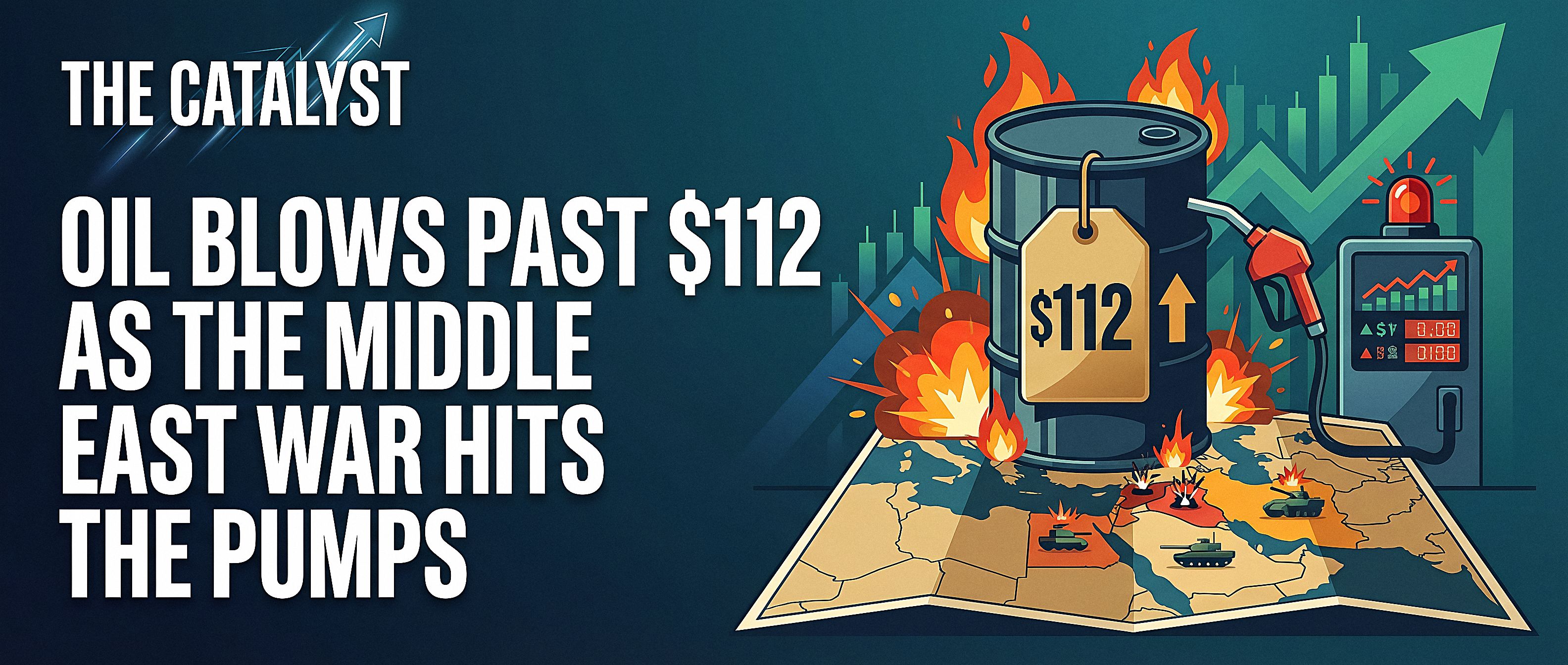
Brent crude surged 3.3% on Friday to close at $112.19 a barrel — the highest level since July 2022. WTI settled at $98.32.
The latest spike came from two directions at once: Iraq declared force majeure on all oilfields developed by foreign companies, and drones struck two major refineries in Kuwait.
Iraq's move, announced on March 17, effectively halted exports through the Strait of Hormuz, which has been partially shut since the U.S.-Israel air campaign against Iran began on February 28.
The Rumaila oil field — one of the world's largest — had already started winding down earlier this month because tankers simply couldn't leave. Meanwhile, the Kuwait attacks forced a precautionary shutdown at the Mina Al-Ahmadi refinery, one of the region's largest.
Why it matters: this is now the largest supply disruption in the history of the global oil market. Crude flows through the Strait of Hormuz have plunged from about 20 million barrels per day before the war to a trickle, and Gulf states including Saudi Arabia, the UAE, Kuwait, and Qatar have all cut production or declared force majeure. Iran has struck ports and refineries across the region in retaliation.
The pain is already showing up at the pump.
The national average for a gallon of regular gas hit $3.93 this week, up nearly a dollar since early March when prices were still below $3.00. California is already above $5.
Late Friday evening, Treasury Secretary Scott Bessent tried to calm markets by issuing General License U — a one-month authorization allowing the sale of roughly 140 million barrels of sanctioned Iranian crude currently sitting on tankers at sea.
It's an unusual move: temporarily lifting sanctions on oil from the country you're at war with. But analysts say even those barrels would only offset about two weeks of disrupted Hormuz flows.
Citi now expects Brent to climb to $120 in the next one to three months, with $150 in a worst-case scenario.
Saudi officials have reportedly told the WSJ that prices could top $180 if disruptions stretch into late April.
On the flip side, Israeli PM Netanyahu said the war "may end sooner than people think."
Markets will hang on every headline this week.
RATE TODAY’S EDITION
What did you think of today's newsletter?Let us know what you liked, what you didn't, and what you'd like to see in future editions. |
⚠️ Disclaimer: Not financial advice. Do your research before making any trades.