- DAY TRADING 📈
- Posts
- Nvidia's $2 Billion Power Move 💪
Nvidia's $2 Billion Power Move 💪
PLUS: Gas hits $4 a gallon for the first time since 2022, FTX sends $2.2 billion to creditors, and more

DayTrading Dispatch
March 31, 2026
Welcome back to the Day Trading newsletter 📈
Markets staged a relief rally to close out March after the Wall Street Journal reported that Trump is willing to end the Iran war even without reopening the Strait of Hormuz.
The Dow jumped more than 500 points, the S&P 500 gained more than 1%, and the Nasdaq climbed more than 1% - a rare green day in what's been the worst quarter for stocks since 2022.
Buckle up 👇️

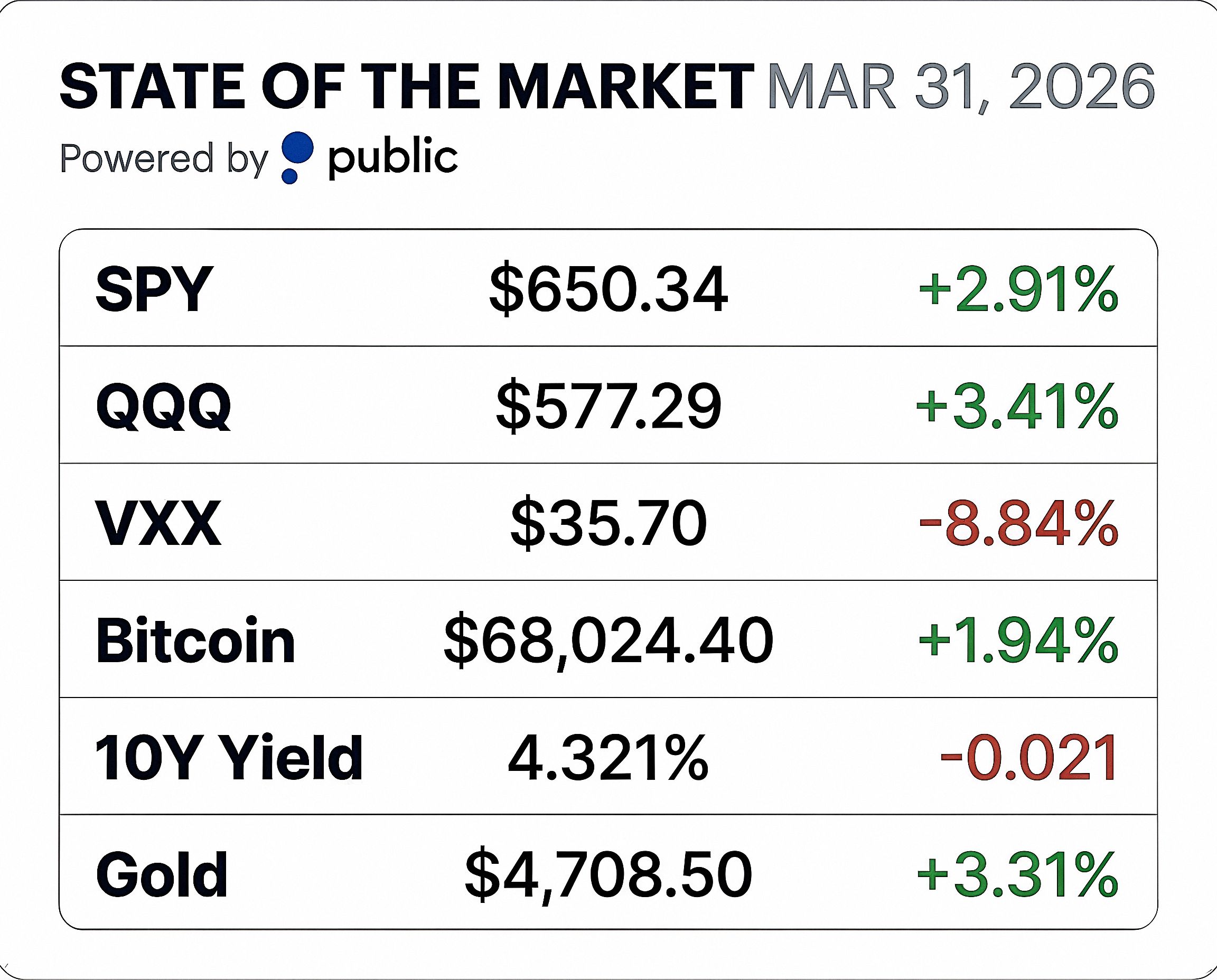
Data updated at 4:18 PM EST. For real-time market data, visit Public.
🔼 The Dow surged more than 500 points after the Wall Street Journal reported that Trump told aides he's willing to end the U.S. military campaign against Iran even if the Strait of Hormuz remains largely closed. Trump assessed that reopening the strait would push the war beyond his four-to-six-week timeline. The S&P 500 and Nasdaq both climbed more than 1% (CNBC)
⛽️ The national average hit $4.018 per gallon, according to AAA - the highest since August 2022. The 34.7% monthly surge is a larger one-month increase than during either the Katrina or Ukraine oil shocks. Diesel has already crossed $5 a gallon, up more than 40% since the conflict began (CNBC)
💵 Fed Chair Jerome Powell said Sunday that inflation expectations remain grounded and the central bank doesn't need to respond to rising energy prices with higher rates. Powell noted that rate moves have a lagged impact, so tightening now wouldn't help with war-driven inflation and could make the economic outlook worse later (CNBC)
💉 Novo Nordisk rolled out multi-month subscriptions for its weight-loss drug Wegovy through telehealth providers including Ro and WeightWatchers, with Hims and Hers and Sesame to follow. A 12-month injection subscription runs $249/month. The program targets self-pay patients without traditional insurance coverage (CNBC)
💰️ The FTX Recovery Trust released $2.2 billion on Tuesday, bringing total distributions to roughly $10 billion since the recovery process began in early 2025. Many customer claim classes will now reach 100% recovery, with some receiving up to 120%. Funds are arriving via BitGo, Kraken, and Payoneer (Coindesk)
📈 The Conference Board Consumer Confidence Index rose to 91.8 from 91.0 in February, beating economists' expectations of 87.9. The present situation index jumped 4.6 points to 123.3 on improved views of the labor market. However, the expectations index slipped to 70.9 - and the survey largely predates the worst of the oil price spike (Bloomberg)
🛢️ WTI crude settled at $102.24 and Brent closed at $106.56 - both holding above $100 as the war continues to disrupt flows through the Strait of Hormuz. Brent is on pace for its largest monthly gain on record since the futures contract was created in 1988. Oil has surged more than 50% since the conflict began in late February (CNBC)
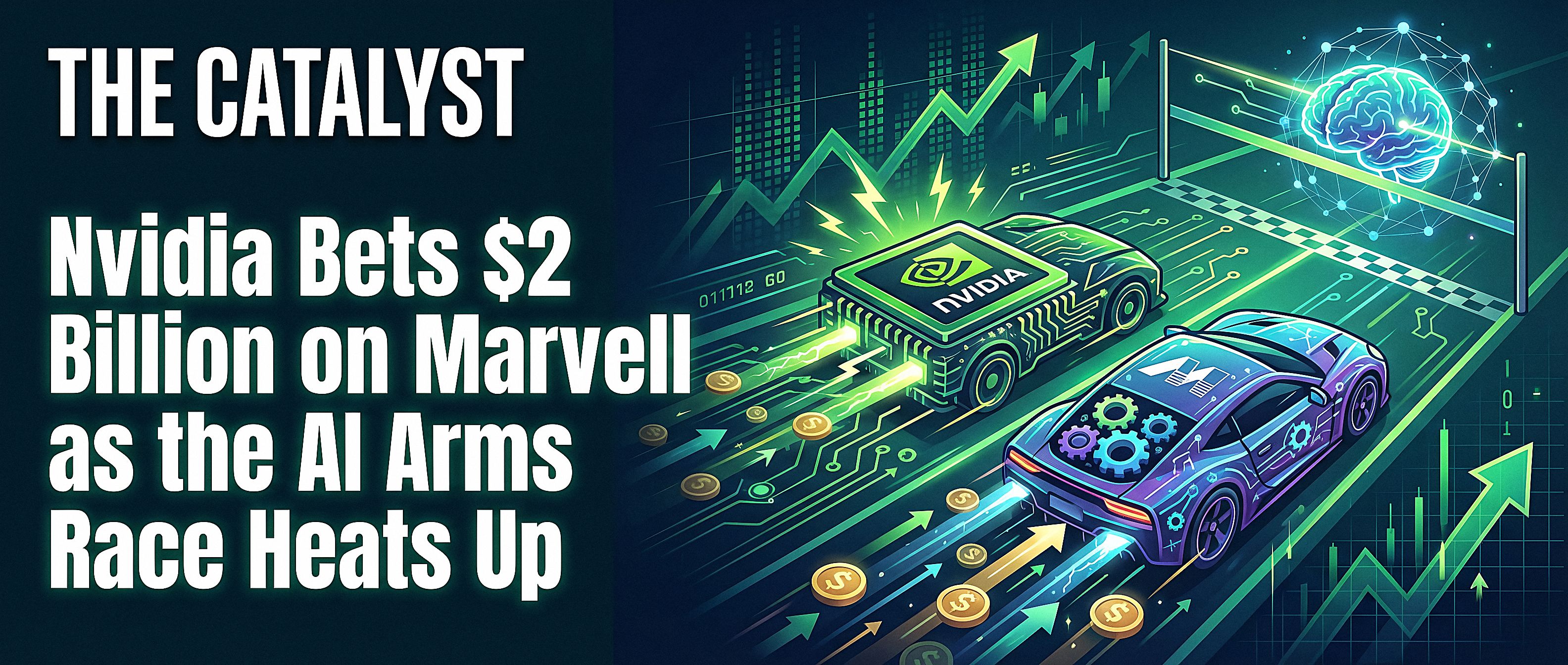
Nvidia is writing another $2 billion check.
The chipmaker announced Tuesday that it's taking a $2 billion stake in Marvell Technology and bringing Marvell into its NVLink Fusion ecosystem - the high-speed interconnect platform that lets companies build semi-custom AI data center infrastructure on top of Nvidia's core networking tech.
Marvell shares surged as much as 13% on the news, while Nvidia rose about 3%.
This is part of a pattern. Over the past four months, Nvidia has made $2 billion strategic investments in Synopsys, CoreWeave, Nebius Group, Coherent, and Lumentum - all aimed at cementing its grip on every layer of the AI infrastructure stack.
CEO Jensen Huang called each deal "an expansion of our ecosystem." The Marvell deal is the latest in that string, and it signals that Nvidia isn't just selling GPUs anymore - it's building an empire around them.
What makes the Marvell partnership stand out is the scope:
Marvell will bring its custom XPUs - specialized AI processors designed for specific workloads - and NVLink Fusion-compatible scale-up networking hardware into Nvidia's platform.
The two companies will also co-develop silicon photonics, a technology that uses light instead of copper wiring to move data faster between chips.
And they'll partner on AI-RAN, an effort to transform telecom networks into AI computing infrastructure for 5G and 6G.
Nvidia is contributing its Vera CPU, ConnectX NICs, Bluefield DPUs, and Spectrum-X switches to the collaboration. The NVLink Fusion chiplet at the core of the platform delivers up to 1.8 terabytes per second of bidirectional bandwidth.
What to watch: Whether Nvidia's $2 billion bet factory translates into ecosystem lock-in or just expensive optionality.
Marvell is a custom chip leader with deep ties to hyperscalers like Amazon and Microsoft.
If NVLink Fusion becomes the connective tissue of AI data centers, Nvidia won't just own the compute layer - it'll own the plumbing too.
Marvell reports Q1 earnings in late May, which will be the first real read on whether this partnership is already generating revenue momentum.
RATE TODAY’S EDITION
What did you think of today's newsletter?Let us know what you liked, what you didn't, and what you'd like to see in future editions. |
⚠️ Disclaimer: Not financial advice. Do your research before making any trades.