- DAY TRADING 📈
- Posts
- Intel Just Joined Elon's $25B Chip Factory 💸
Intel Just Joined Elon's $25B Chip Factory 💸
PLUS: US-Iran ceasefire crashes oil 16 percent, the Fed dusts off rate hikes, and more...

DayTrading Dispatch
April 09, 2026
Welcome back to the Day Trading newsletter 📈
A ceasefire just broke the fever. The U.S. and Iran agreed to a two-week pause, the Strait of Hormuz is set to reopen, and Wall Street responded with its best day in a year: the Dow ripped 1,325 points, oil cratered 16%, and the S&P 500 surged 2.51% to 6,782.
Let’s get into it 👇️

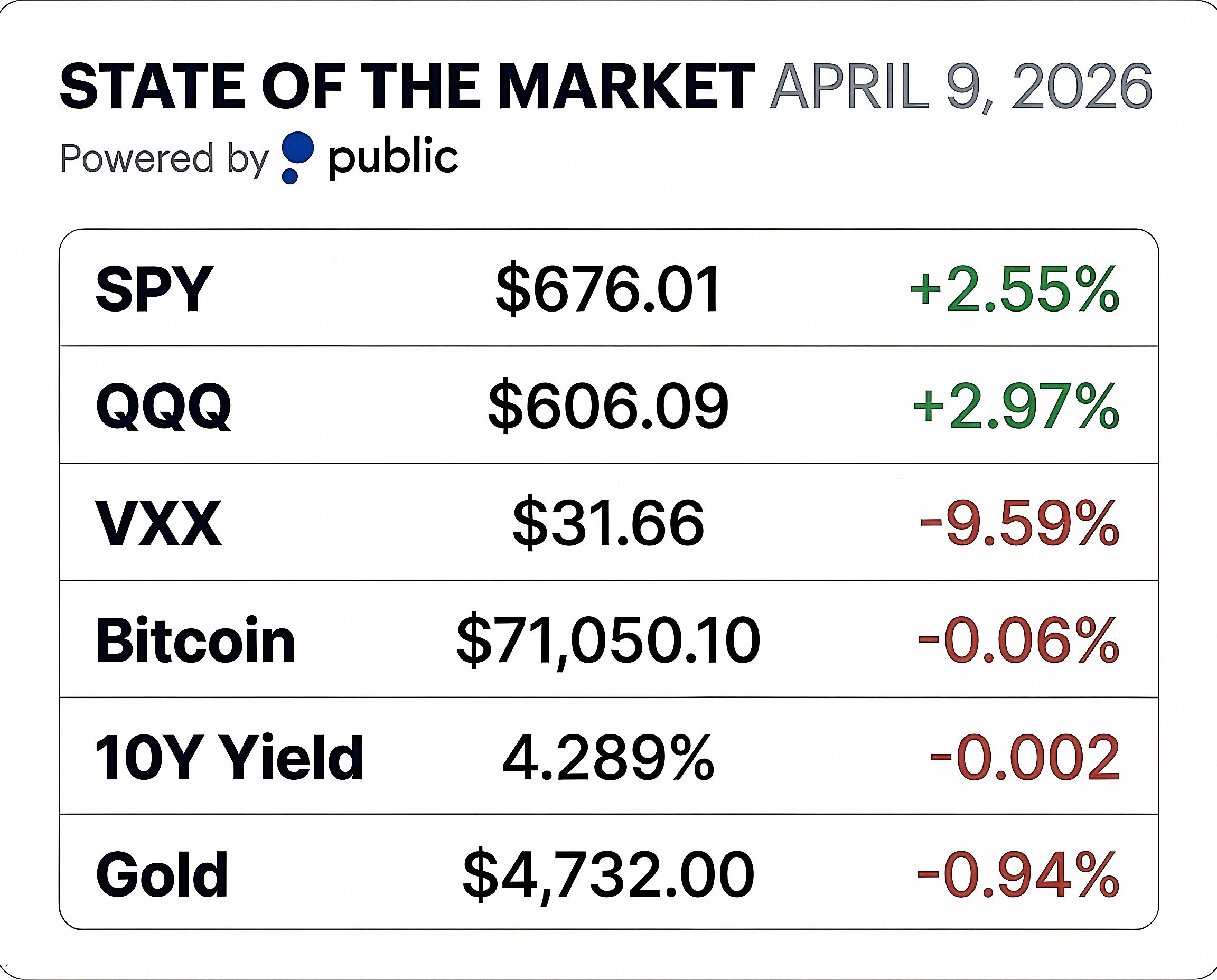
Data updated at 3:00 AM EST. For real-time market data, visit Public.
🤝 President Trump suspended strikes on Iran after receiving a 10-point proposal he called a "workable basis for negotiations," contingent on Iran reopening the Strait of Hormuz. Pakistan brokered the deal, with both sides expected in Islamabad on April 10 for in-person talks. Reports of attacks just hours into the truce raise questions about whether it holds. (CNBC)
📈 The Dow surged 1,325 points (2.85%) to 47,909 -- its best session since April 2025. The S&P 500 jumped 2.51% to 6,782 and the Nasdaq gained 2.80% to 22,635. Travel, industrials, and tech all benefited from falling oil and reduced geopolitical risk, while energy producers lagged as crude's collapse hit their revenue outlook. (CNBC)
🛢️ WTI crude cratered more than 16% to settle at $94.41 per barrel after the ceasefire erased the war premium that had pushed prices above $112 earlier this week. Brent also fell more than 13%. The move immediately eased inflation fears tied to the five-week Strait of Hormuz closure, though traders are cautious given the ceasefire window is only two weeks. (Fortune)
✈️ Delta reported adjusted Q1 earnings of $0.64 per share on record March-quarter revenue of $14.2 billion, beating the $13.94 billion revenue estimate even as fuel costs surged. The stock jumped 12% as the oil crash gave the entire sector a jolt -- American Airlines surged 11%, United rose nearly 10%, and Carnival popped 11% on the cruise side. (CNBC)
🏦 The March Fed minutes revealed some officials discussing rate increases for the first time this cycle, noting that upside risks to inflation and downside risks to employment were both elevated. The committee held at 3.50-3.75% with one dissent. The ceasefire may now shift that calculus, but Friday's March CPI report will be the next key input. (Federal Reserve)
✨ Meta unveiled Muse Spark, a proprietary AI model built by its new Superintelligence Labs unit led by Alexandr Wang. Unlike Meta's previous open-weight releases, Muse Spark is closed -- available only through a private API preview for select partners. The stock rallied 6.5% to $612.42 as the model rolls out across Facebook, Instagram, WhatsApp, and Ray-Ban Meta glasses. (CNBC)
🥇 Spot gold touched $4,802 in early Wednesday trading before the ceasefire pulled prices down to around $4,705-4,750 by afternoon -- a roughly $50-100 intraday swing. The move shows how much of gold's recent run was war-premium driven, though prices remain near record levels on continued central bank buying and ETF inflows. (Fortune)
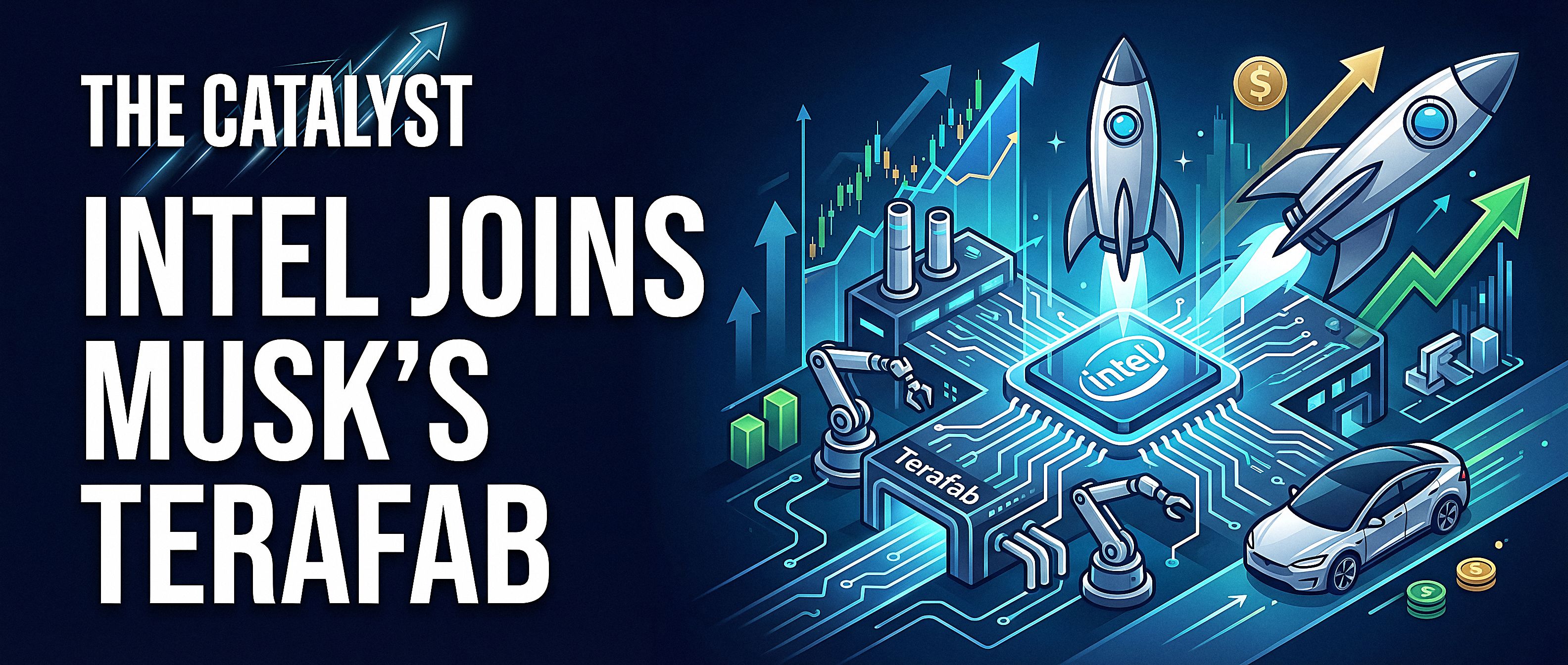
Intel surged 11.4% Wednesday to close at $58.95 after confirming it's joining Terafab, Elon Musk's $20-25 billion joint-venture semiconductor complex being built on the north campus of Giga Texas in Austin.
The project is a collaboration between Tesla, SpaceX, and xAI, with a stated goal that sounds like science fiction: one terawatt of AI compute per year.
Intel's contribution is specific and significant. The company is bringing its 18A process node (a 1.8-nanometer-class technology that represents the most advanced semiconductor manufacturing currently produced entirely within the United States).
Intel also brings high-volume fabrication expertise and advanced packaging, meaning it's not just lending its name to the project.
It's providing the industrial backbone that would make Terafab actually function as a real fab, not just a press release.
Reuters reported that Terafab will house two dedicated fabs: one producing edge AI chips for Tesla's autonomous vehicles and Optimus humanoid robots, and another manufacturing radiation-hardened chips for SpaceX's orbital AI data centers.
The plan calls for 80% of compute output to target orbital infrastructure, with 20% for ground-based applications.
That's ambitious, to put it mildly.
Independent analysts have expressed sharp skepticism that the $25 billion headline figure is anywhere close to what this kind of project would actually cost.
Still, the market sees Intel as a winner here regardless of Terafab's ultimate timeline: trading volume hit 179.7 million shares (64% above the three-month average), and the stock has gained roughly 16% over two sessions.
What to watch: whether the $25 billion budget gets revised upward, whether other semiconductor equipment companies get pulled into the project, and how Intel's balance sheet handles the commitment while it's still ramping its own foundry business.
RATE TODAY’S EDITION
What did you think of today's newsletter?Let us know what you liked, what you didn't, and what you'd like to see in future editions. |
⚠️ Disclaimer: Not financial advice. Do your research before making any trades.