- DAY TRADING 📈
- Posts
- Google Takes Two Swings at Nvidia 🥊
Google Takes Two Swings at Nvidia 🥊
PLUS: Intel pops 20% on AI demand, ServiceNow loses a sixth of its value, Tesla sinks on a $25B capex shock, and more...

DayTrading Dispatch
April 23, 2026
Welcome back to the Day Trading newsletter 📈
The Nasdaq and S&P 500 pulled back from Wednesday's record highs Thursday as a brutal software rout led by ServiceNow and IBM collided with a fresh oil spike out of the Strait of Hormuz.
Then Intel stole the bell with a 20% after-hours rip on a clean Q1 beat, and Google rolled out its most direct swing yet at Nvidia.
Let’s get into it 👇️


Data updated at 7:00 PM EST.
For real-time market data, visit Public.
📉 The S&P 500 slipped 0.41% to 7,108.40 Thursday as a brutal software rout and a fresh oil spike pulled the major averages back from Wednesday's records. The Nasdaq Composite dropped 0.89% to 24,438.50 and the Dow shed 179.71 points (0.36%) to 49,310.32, with ServiceNow and IBM leading the drawdown as WTI climbed for a fourth straight session and U.S.-Iran peace talks showed little progress. (Bloomberg)
🤑 Intel shares jumped roughly 20% in after-hours trading Thursday on a clean Q1 beat driven by surging AI demand. Revenue came in at $13.6 billion (+7% YoY) with adjusted EPS of $0.29 against a one-penny loss expected, and Data Center and AI revenue rose 22% to $5.1 billion. Q2 guidance of $13.8–$14.8 billion topped consensus — the first beat-and-raise under the new CEO. (CNBC)
🚗 Tesla fell about 3.5% Thursday after management unveiled a 2026 capex plan north of $25 billion, roughly $5 billion above prior guidance and nearly triple last year's spend. Q1 adjusted EPS of $0.41 beat the $0.37 consensus and auto gross margin of 21.1% crushed the 17.5% Street estimate, but the capex shock to fund Cybercab, Optimus, Semi, and a new "Terafab" project overshadowed the beat. (Motley Fool)
😓 ServiceNow closed down 17.6% Thursday to around $84.61 after management flagged a roughly 75-basis-point Q1 subscription-revenue headwind from large Middle East on-prem deals stalling on the Iran war. The company also guided adjusted gross margin to 81.5% versus the 82.1% Street estimate, citing the Armis acquisition, and shed more than $50 billion in market cap on the day. (Yahoo Finance)
🖥️ IBM fell about 7.9% Thursday to $231.91 even though Q1 results topped Wall Street on both lines. Non-GAAP EPS of $1.91 beat the $1.81 consensus and revenue of $15.92 billion edged the $15.62 billion estimate on 9% YoY growth, but management left full-year guidance unchanged — which investors read as a tell on AI momentum. IBM is now down roughly 15% YTD. (CNBC)
💳️ American Express beat Q1 estimates on the back of the strongest quarterly card-spending growth in three years. EPS of $4.28 topped the $4.06 consensus on $18.91 billion in revenue (vs. $18.80 billion expected), with net income of $3.0 billion up from $2.6 billion a year earlier and card-member spending growing 10%. Amex reaffirmed full-year 2026 EPS guidance of $17.30–$17.90. (Motley Fool)
🍯 Honeywell beat on earnings, missed on revenue, and nailed down a June 29 spin-off date for its Aerospace unit. Q1 adjusted EPS of $2.45 topped the $2.35 estimate, but revenue of $9.14 billion came in short of the $9.28 billion consensus. Segment margin rose 90 basis points to 23.3%, and the company reaffirmed full-year EPS guidance of $10.35–$10.65. (Honeywell)
🛢️ WTI crude climbed to roughly $94 a barrel Thursday, a fourth straight up day, before briefly spiking near $97 on unverified reports of an explosion in Tehran — later confirmed as a routine military drill. Brent held above $100. Daily transit through the Strait of Hormuz has collapsed to roughly three vessels under Iran's enforcement and the U.S. blockade, even after Trump extended the ceasefire indefinitely Tuesday. (CNBC)
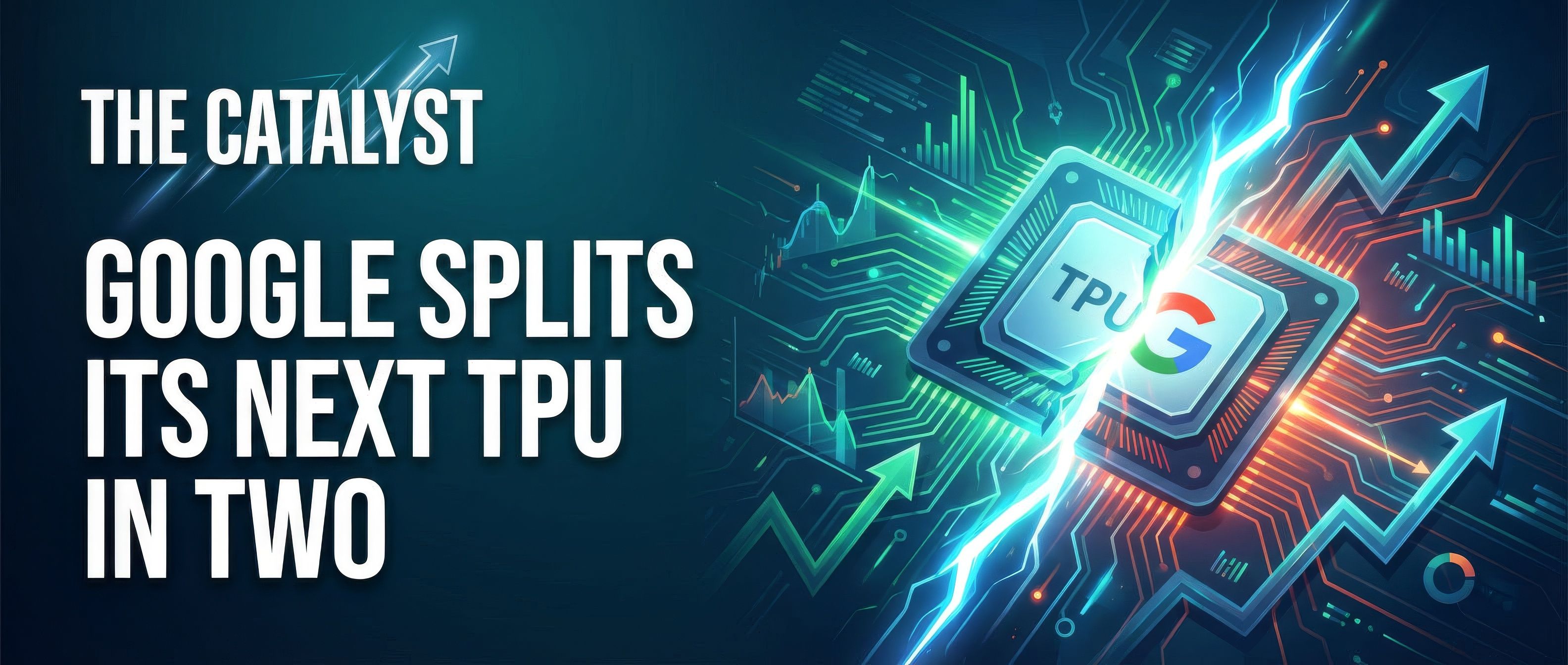
Google used the opening keynote at Cloud Next '26 in Las Vegas on Wednesday to unveil its 8th-generation Tensor Processing Units.
For the first time, the company split the lineup into two purpose-built chips: the TPU 8t for training and the TPU 8i for inference.
The company says 8t delivers 2.8x better price-performance than the prior-generation Ironwood TPU for training workloads, scales up to 9,600 chips in a single cluster backed by two petabytes of shared high-bandwidth memory, and pushes a single pod to 121 exaflops of compute.
CNBC reported the chips are tailored for an "agentic age" and will be generally available later in 2026 as part of Google's AI Hypercomputer stack.
Why it matters: Nvidia still runs the AI hardware table, but the bifurcation strategy is a pointed move. Training and inference have diverged into genuinely different workloads (training is about raw throughput on massive clusters, inference is about cost per token at scale) and by shipping a dedicated chip for each, Google is arguing that a one-size-fits-all GPU is no longer the right answer.
Google also announced a $750 million fund to help partners like Accenture, Deloitte, KPMG, Capgemini and TCS push corporate customers from AI pilots into full deployments. That's the biggest single partner commitment any hyperscaler has made.
It's a direct shot at the CUDA ecosystem moat.
What to watch: Nvidia reports fiscal Q1 results in late May, and any commentary on hyperscaler capex mix will be closely parsed. Google is also committing to engineer joint networking with Nvidia for customers who want both — a hedge that keeps CUDA workloads landing on Google Cloud.
Near term, watch whether Anthropic, Meta or other heavy TPU users commit publicly to 8t at scale, and whether inference pricing across the big clouds starts to compress.
RATE TODAY’S EDITION
What did you think of today's newsletter?Let us know what you liked, what you didn't, and what you'd like to see in future editions. |
⚠️ Disclaimer: Not financial advice. Do your research before making any trades.