- DAY TRADING 📈
- Posts
- Gold Just Had Its Worst Week Since 1983 📉
Gold Just Had Its Worst Week Since 1983 📉
PLUS: Oil crashes 11% on Trump-Iran talks, the Dow surges, and more...

DayTrading Dispatch
March 24, 2026
Welcome back to the Day Trading newsletter 📈
Oil crashed 11%, gold hit a 2026 low, and the Dow surged 631 points (all after President Trump said the U.S. and Iran have had "productive" talks about ending the war).
The safe-haven trade is unraveling in real time. Buckle up 👇️

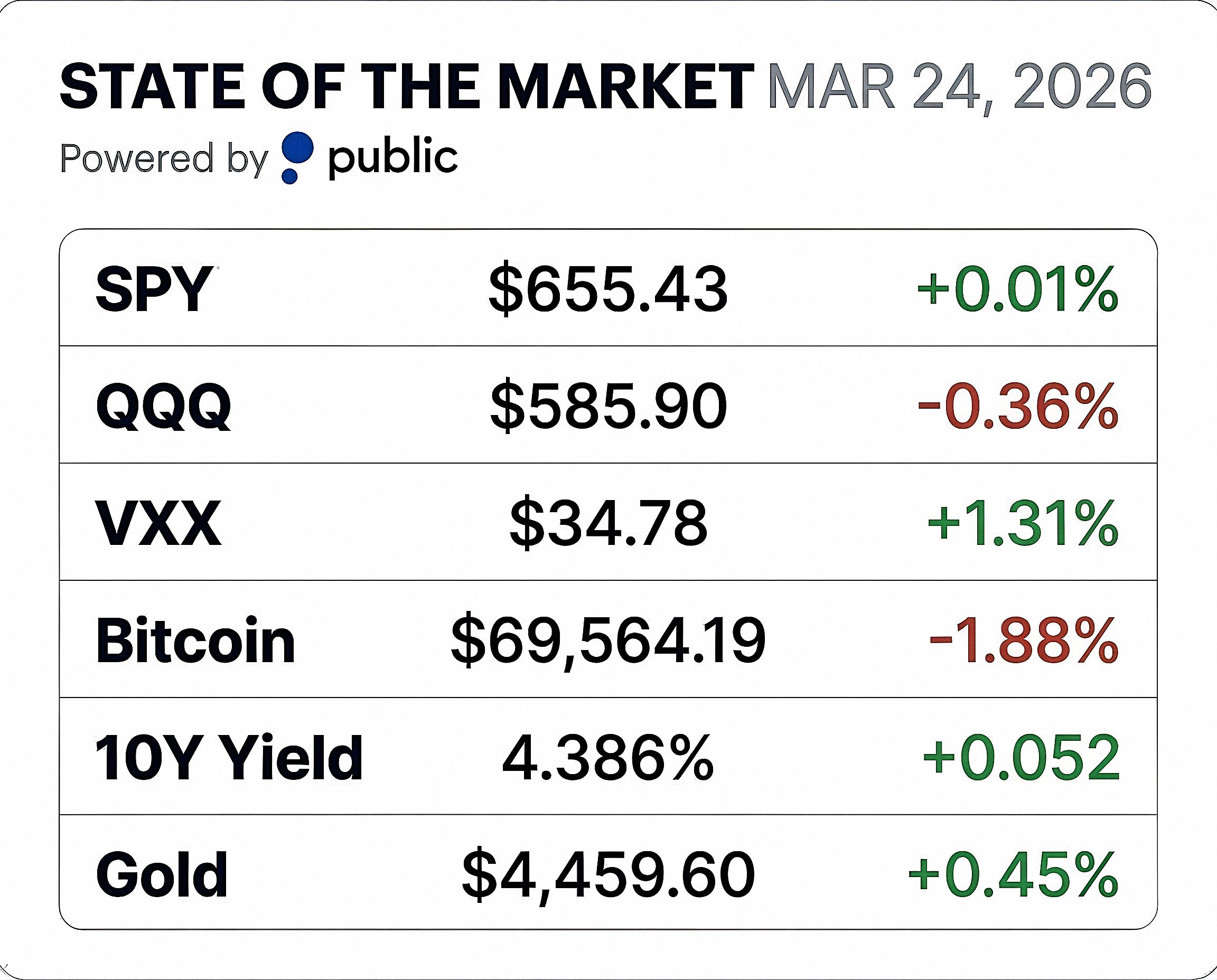
Data updated at 12:50 PM EST. For real-time market data, visit Public.

🛢️ Oil plunged more than 10% on Monday after Trump said the U.S. and Iran had held "productive" talks and he would pause strikes on Iranian energy infrastructure for five days. Brent crude settled at $99.94 a barrel (falling back below $100 for the first time since early March) while WTI closed at $88.13. Despite the drop, prices remain roughly a third higher than before the war started on February 28. (CNN)
📈 The Dow surged 631 points on Monday, closing at 46,208 after Trump's Iran announcement sparked a broad relief rally. The S&P 500 rose 1.15% to 6,581 and the Nasdaq gained 1.38% to 21,947. The Russell 2000 led with a 2.3% jump. It was the market's best day in weeks, though gains faded from earlier highs above 2% as Iran denied that any talks had taken place. (TheStreet)
🌏️ Asian markets cratered Monday morning before Trump's announcement reversed the mood in the West. South Korea's Kospi plunged 6.5% to 5,406 -- triggering a brief program trading halt -- while Japan's Nikkei 225 fell 3.5% to 51,515. Hong Kong's Hang Seng dropped 3.5% to 24,382. The sell-off came after Trump threatened over the weekend to "obliterate" Iran's power plants if Tehran didn't reopen the Strait of Hormuz within 48 hours. (CNBC)
🚢 Iran has started charging some commercial vessels up to $2 million per voyage to pass through the Strait of Hormuz, effectively imposing an informal toll on the world's most important energy chokepoint. The fees are being collected on an ad hoc basis, and Iran's parliament is advancing a proposal to formalize the charges as part of a postwar settlement. About 20% of the world's oil supply transits the strait. (Yahoo Finance)
⛽️ Chevron CEO Mike Wirth warned Monday that the oil market still hasn't fully priced in the supply disruption from the Strait of Hormuz closure. "We got a lot of oil and gas now that is not flowing into the market. There really is a difference in terms of physical supply this time versus prior incidents," Wirth told CNBC. He added that rebuilding inventories will take time even if the strait reopens. (Benzinga)
🔴 Bitcoin whipsawed, dipping to $68,000 and triggering hundreds of millions of dollars in crypto liquidations before rebounding above $70,000 after Trump's Iran announcement. The crypto fear-and-greed index sits at 25 (deep in "extreme fear" territory). Spot Bitcoin ETFs had strung together a seven-day inflow streak last week before it snapped on March 18 with $130 million in outflows. (CoinDesk)
🪙 Silver has entered a full-blown bear market, falling more than 40% from its January all-time high near $121 per ounce. The metal dipped as low as $67 last week and was trading near $72 on Friday. The collapse has been driven by a surging U.S. dollar, margin requirement hikes from CME Group that forced smaller traders to liquidate, and billions in outflows from the SLV ETF this year. (Yahoo Finance)
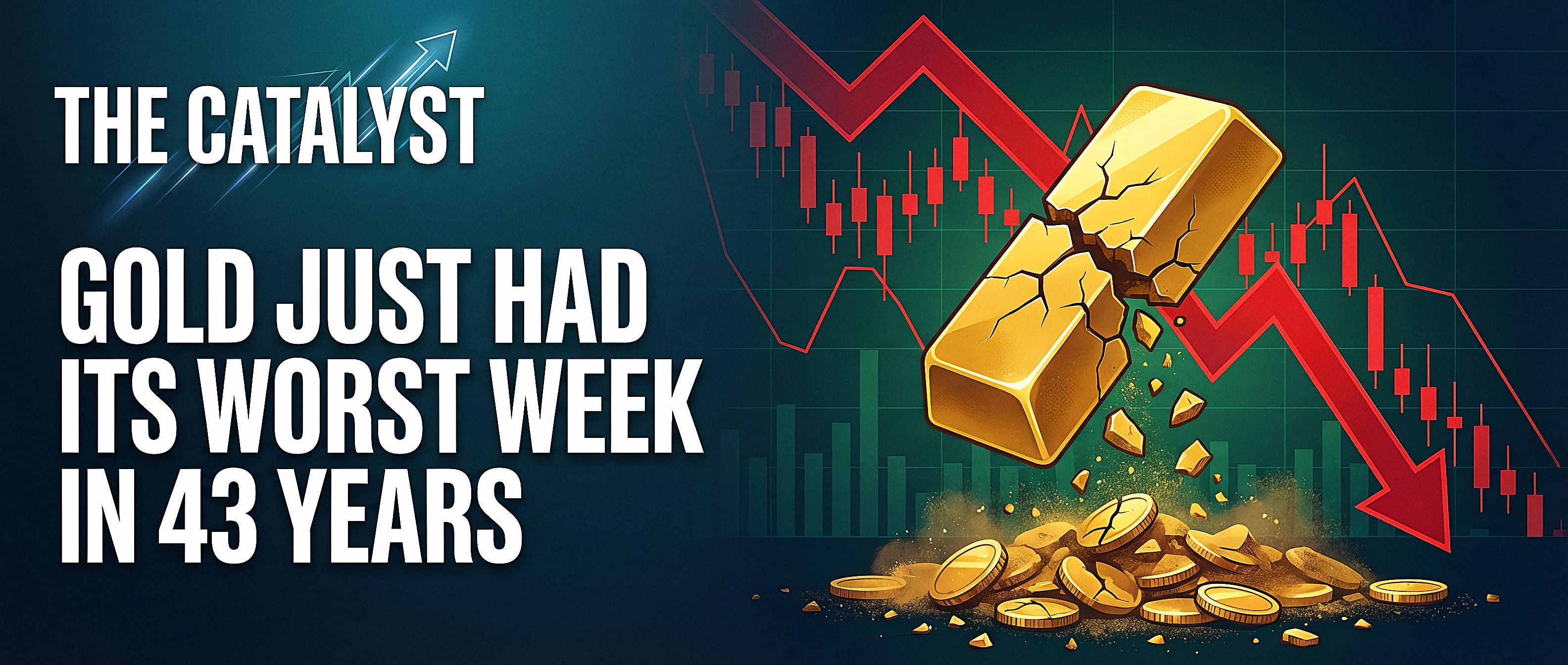
Gold capped its worst week since 1983 on Friday, then kept falling Monday.
April futures closed at $4,407 on March 23 after briefly dipping below $4,300 intraday (the metal's lowest level of 2026). The weekly loss came in around 10.8%, and gold is now down roughly 21% from its record high near $5,590 set in late January.
So what killed the rally? Two things converged at once.
First, the Federal Reserve held rates steady at 3.5%-3.75% at its March 18 meeting, and with the Fed raising its inflation forecast to 2.7% for 2026, rate cut expectations have dimmed sharply -- the dot plot now points to just one cut this year. That's a problem for gold because the metal pays no yield -- when rate cuts get pushed out, money flows out of gold and into Treasuries.
Second, President Trump announced Monday that the U.S. and Iran had engaged in "productive conversations" about ending the war, and he postponed all planned strikes on Iranian energy infrastructure for five days.
That one-two punch (hawkish Fed plus geopolitical de-escalation) ripped the floor out from under the fear trade that had propelled gold above $5,500 just two months ago.
The speed of the unwind caught traders off guard.
Speculative long positions built up during the Iran crisis got flushed as paper traders scrambled to cut exposure, amplifying the sell-off beyond what fundamentals alone would suggest.
The U.S. Dollar Index pushed past 100, adding another headwind. A stronger dollar makes gold more expensive for international buyers, which further dampens demand.
What to watch: Despite the carnage, the big banks aren't calling a top. J.P. Morgan is maintaining its year-end target of $6,300 per ounce, and Deutsche Bank stands behind $6,000.
Their argument is that the structural forces that drove gold's 2025 rally (central bank buying, de-dollarization, and fiscal deficits) haven't changed.
If the Iran de-escalation stalls and rates stay flat, gold could rebound fast.
But if Trump actually lands a deal with Tehran, the geopolitical premium may not come back for a long time.
RATE TODAY’S EDITION
What did you think of today's newsletter?Let us know what you liked, what you didn't, and what you'd like to see in future editions. |
⚠️ Disclaimer: Not financial advice. Do your research before making any trades.