- DAY TRADING 📈
- Posts
- An oil bet worth half a billion 🛢️
An oil bet worth half a billion 🛢️
PLUS: Odds of a recession increase, SpaceX prepares its S-1, and more...

DayTrading Dispatch
March 26, 2026
Welcome back to the Day Trading newsletter 📈
Monday's relief rally evaporated a bit after Iran rejected the U.S. ceasefire plan, oil surged back above $106, and Wall Street started quietly raising recession odds.
The war's fourth week brought more whiplash than clarity, and one trading mystery that has Washington asking hard questions.
Buckle up 👇️

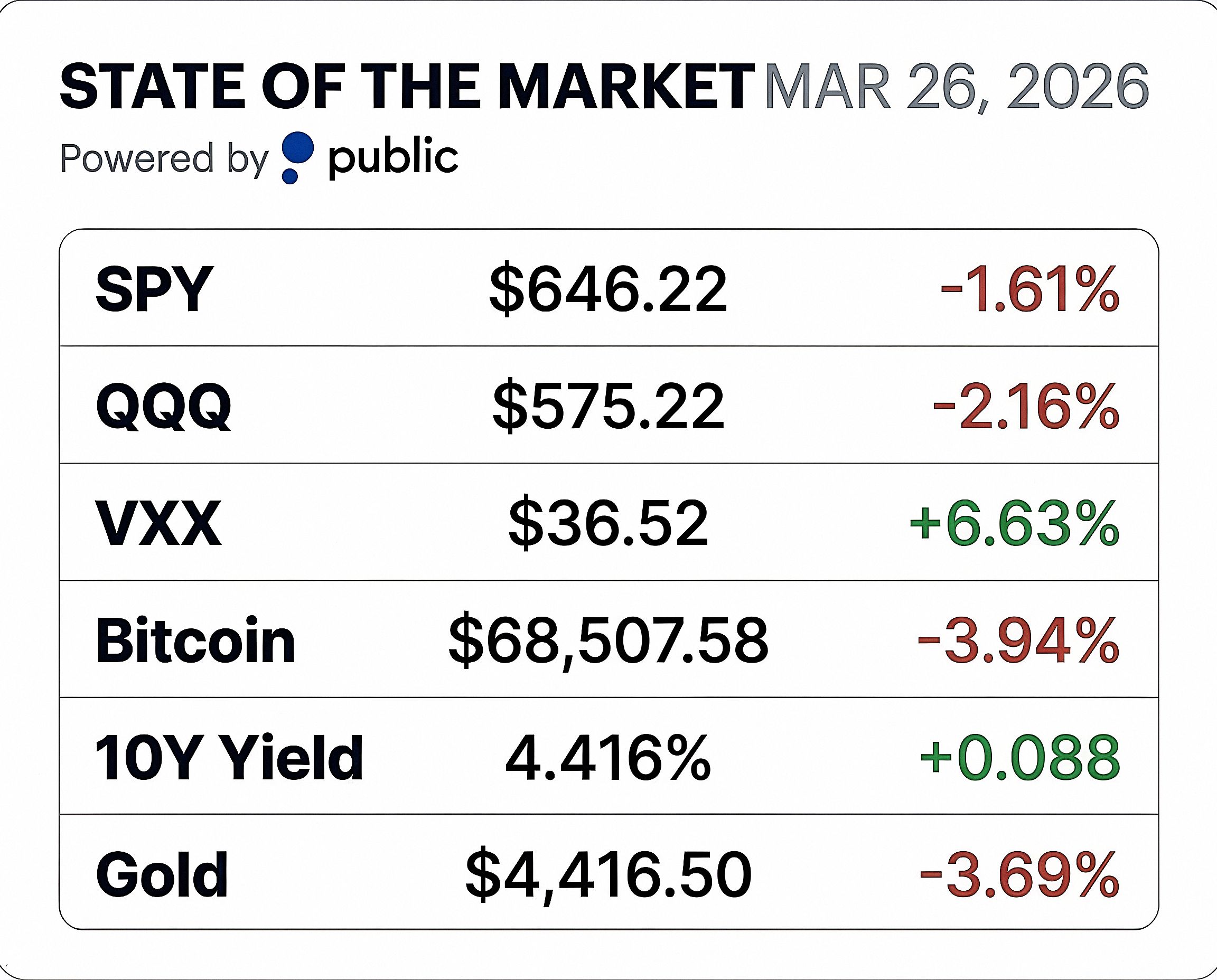
Data updated at 3:50 PM EST. For real-time market data, visit Public.
📜 Tehran called Trump's 15-point "Strategic De-escalation Plan", which offered sanctions relief in exchange for nuclear rollback and reopening the Strait of Hormuz, "extremely maximalist and unreasonable." Foreign Minister Abbas Araghchi said Iran doesn't want a ceasefire at all, but rather "the war to end in a way that it does not repeat, on our own terms." Iran's five counter-demands include war reparations and full sovereignty over the Strait of Hormuz. (CNBC)
🇺🇸 Goldman bumped its 12-month U.S. recession probability from 25% to 30%, citing surging oil, sluggish growth, and fading policy support. JPMorgan is even more cautious at 35%, warning markets are "still complacent" about a sustained oil shock. Moody's Analytics has the highest reading on Wall Street at 48.6%. In normal times, baseline recession risk for any given 12-month period sits around 20% (CNBC)
⛽️ The national average for regular gasoline hit $3.98, according to AAA, up from $2.98 just four weeks ago. That's a 35% jump driven by crude oil's war premium and rising spring break demand. The last time the national average topped $4 was August 2022. Prices could cross that threshold in the coming days. (AAA)
🚀 SpaceX is finalizing its S-1 prospectus and could file with the SEC as early as this week, seeking a valuation of roughly $1.75 trillion. If the company raises the projected $75 billion-plus, it would dwarf Saudi Aramco's $29.4 billion record. The valuation is anchored by Starlink, which doubled its subscriber base to 9.2 million in 15 months and generated over $10 billion in revenue last year. A June listing is the current target. (CNBC)
💰️ Bitcoin has been range-bound between $68,000 and $72,000 all week, holding the psychological $71K level but showing no momentum in either direction. The crypto Fear and Greed indesx dropped to 14 -- the lowest reading in 11 weeks and deep in "extreme fear" territory. Bitcoin's market cap sits at roughly $1.33 trillion, but risk appetite across the board remains nonexistent while the war grinds on. (Blockchain Magazine)

On Monday morning, between roughly 6:49 and 6:50 a.m. Eastern, about 6,200 Brent and WTI crude futures contracts changed hands: a notional value of approximately $580 million.
Sixteen minutes later, President Trump posted on Truth Social that the U.S. and Iran had held "productive conversations" about ending the war, and that he was pausing all planned strikes on Iranian energy infrastructure for five days. Oil prices crashed more than 10% that day.
The timing is what makes this extraordinary. The average trading volume for that same time window over the previous five trading days was about 700 contracts.
Monday's burst was nearly nine times that, and there were no scheduled economic releases, no Fed speeches, and no other market-moving events on the calendar that morning.
Whoever placed those trades stood to profit enormously from the oil plunge that followed Trump's post, and multiple investigations by NPR, CBS, Fortune, and Axios all converged on the same question:
Who knew?
Nobel laureate economist Paul Krugman didn't mince words, calling the trades "treason" in a post that went viral. The White House pushed back, spokesperson Kush Desai said the administration "does not tolerate any administration official illegally profiteering off of insider knowledge" and called the reporting "baseless and irresponsible."
But the denial hasn't quieted the scrutiny. Market experts like Stephen Piepgrass told reporters that the volume spike alone is "certainly enough to raise eyebrows, and I think to launch an investigation."
The CFTC, which oversees commodity futures markets, has not publicly commented on whether it has opened a formal probe.
Congress could step in; suspiciously timed trades around presidential announcements touch on national security, not just securities law.
Meanwhile, the episode sits alongside the Polymarket story from earlier this week, where eight newly created accounts wagered roughly $70,000 on an Iran ceasefire days before Trump's announcement and stand to win nearly $820,000.
Whether or not regulators act, the pattern is becoming hard to ignore.
RATE TODAY’S EDITION
What did you think of today's newsletter?Let us know what you liked, what you didn't, and what you'd like to see in future editions. |
⚠️ Disclaimer: Not financial advice. Do your research before making any trades.